
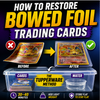
How to Restore Bowed Foil Trading Cards and Keep Them Flat
, by TCG Xtreme, 12 min reading time
, by TCG Xtreme, 12 min reading time
Foil trading cards are among the most attractive cards in any collection. Their reflective surfaces, special patterns, and premium appearance make them popular with collectors and players alike. Unfortunately, foil cards are also especially prone to bowing or curling.
A card that once sat perfectly flat may gradually develop a noticeable curve. The corners may lift from the table, the center may arch upward, or the entire card may take on a spoon-like shape. Severe bowing can make cards difficult to shuffle, store, display, or submit for grading. In some competitive card games, a noticeably curved foil may even be considered marked because it can be identified while face down in a deck.
The good news is that many bowed foil cards can be made significantly flatter. The safest methods rely on controlled humidity, gentle pressure, and proper storage rather than force or heat.
This guide explains why foil cards bow, several ways to flatten them, and a simple Tupperware method that can work especially well for cards curled by dry conditions.
Most foil cards are made from multiple layers. A typical card includes a paper or cardboard core, printed layers, coatings, adhesive, and a thin foil or metallic layer.
These materials react differently to changes in humidity and temperature. The paper portion of the card absorbs and releases moisture from the air. When it absorbs moisture, it may expand slightly. When it dries out, it may contract. The foil layer changes much less.
Because one side of the card moves more than the other, tension develops between the layers. The card bends instead of remaining flat.
This is why foil cards often become more curved during very dry winters, in heavily air-conditioned rooms, or in humid basements. A card may also change shape after being moved from one climate to another.
Before choosing a restoration method, remember that bowing can be caused by either too little moisture or too much moisture. A humidity-increasing method can help an overly dry card but may make a moisture-saturated card worse. Start with a small group of inexpensive cards until you understand how your cards respond.
Flattening a foil card should be a gradual process. Aggressive techniques can create permanent damage, including creases, dents, surface scratches, cloudy foil, peeling layers, or water staining.
Never place a trading card directly in water. Do not wipe it with a wet cloth or spray it with water. The goal is to adjust the humidity around the card, not to get the card wet.
Avoid irons, ovens, microwaves, heat guns, hair dryers, radiators, and direct sunlight. Heat can warp card layers, weaken adhesives, alter finishes, and permanently damage the foil.
Wash and dry your hands before handling cards, or use clean card-handling gloves. Place cards in clean penny sleeves when possible, especially before applying pressure. Make sure every surface touching the cards is smooth and free of dust.
For rare, irreplaceable, or extremely valuable cards, consider consulting a professional paper or collectibles conservator. Any home treatment carries some risk, even when performed carefully.
The simplest method is to place the bowed card under steady, even pressure.
Start by putting the card in a clean penny sleeve. Place it between two smooth, rigid, acid-free surfaces. Thick books, clean acrylic sheets, archival boards, or flat pieces of smooth cardboard can work.
Add a moderate amount of weight on top. A few large books are usually enough. Leave the card pressed for several days and check it periodically.
Pressure alone works best for mild bowing. It is less effective when the card’s moisture balance is still causing it to curl. A card may appear flat immediately after being pressed but begin bowing again once the weight is removed.
For better results, combine gentle pressure with a controlled humidity adjustment. Once the card becomes flat, move it directly into a rigid holder, binder, or closely packed storage box.
Do not place extreme weight on the card. More pressure does not necessarily produce a better result. Too much weight can emboss the surface, press debris into the finish, or damage textured foils.
The Tupperware method is a convenient way to introduce a small amount of moisture into a sealed environment without allowing the cards to touch water.
This method is most useful for foil cards that have bowed because the paper layer has become too dry. It should be performed carefully and monitored closely.
You will need:
Choose a container large enough to keep the water and cards completely separate. The water container should be difficult to tip over.
Place your stack of cards on one side of the large container. Work with no more than approximately 10 to 30 cards at a time. A smaller group is easier to monitor and allows the humidity to affect the cards more evenly.
On the opposite side, place a small container of water. Do not pour water directly into the bottom of the large container. The cards must never touch the water, and condensation should not drip onto them.
You may place a small, evenly distributed weight on top of the card stack. The weight should be clean and smooth. Avoid anything heavy enough to dent the cards or press sleeve seams into their surfaces.
Close the lid securely and leave the container on the counter for approximately 30 to 40 minutes.
After 30 minutes, open the container and inspect the cards. They may already feel more flexible and appear noticeably flatter. If they are still bowed, you can reseal the container for a short additional interval, checking frequently.
Do not leave the cards unattended in the humid container for many hours. The amount of humidity can vary depending on the container’s size, room temperature, amount of water, local climate, and how tightly the lid seals. Longer exposure is not automatically better.
Once the cards are flat, remove them promptly. Place each card in a sleeve and then into a toploader, card saver, binder page, or another flat storage system. This helps the card retain its improved shape as it returns to normal room conditions.
The sealed container creates a humid microenvironment. The card’s paper layers slowly absorb a small amount of moisture from the air. This can reduce the tension between the cardstock and foil layers, allowing the card to relax toward a flatter shape.
The weight encourages the cards to settle flat while their moisture content changes.
The water should only humidify the air. There should never be direct contact between the cards and liquid water.
The biggest mistake is leaving the cards inside for too long. Excessive humidity can cause the cards to curl in the opposite direction, become wavy, soften around the edges, or develop surface and layer damage.
Another common mistake is using an unstable water cup. If the cup spills, the cards may be ruined. Use a wide, low container and keep plenty of distance between the cards and the water.
Watch for condensation. If droplets form on the lid or walls, remove the cards. A properly controlled setup should feel humid, but the cards should remain completely dry.
It is wise to test the method using inexpensive cards from the same product or set before treating anything valuable.
Two-way humidity-control packs can provide a more measured alternative to an open container of water. These packs are commonly used for products that need a stable humidity level.
Place the cards and an appropriate humidity pack in a sealed plastic container, ensuring the pack does not rest directly against the cards unless the manufacturer indicates that contact is safe. Check the cards at regular intervals.
This method is slower than using an exposed cup of water, but the environment may be easier to control. The best humidity level depends on the cards, their construction, and the climate in which they are stored. Moderate, stable humidity is generally preferable to rapid swings between extremely dry and extremely damp conditions.
After the cards flatten, store them under light pressure in sleeves and rigid holders.
Not every bowed foil needs more humidity. Cards stored in damp rooms may have absorbed too much moisture.
In that situation, use a sealed container with a drying material such as a fresh silica-gel packet. Keep the packet separate from the cards and check the cards frequently. A plastic tray or divider can prevent direct contact.
The goal is gradual moisture reduction. Using a large amount of desiccant for an extended period may make the cards overly dry and cause them to curl in the opposite direction.
Begin with short sessions. Once the cards improve, move them into flat storage in a room with more stable conditions.
Never reuse mystery desiccant packets that may be saturated, contaminated, or intended for industrial products. Use clean packets designed for ordinary storage purposes.
A side-loading binder with firm pages can help correct mild bowing and prevent cards from curling again.
Sleeve each card before placing it in the binder. Distribute the cards throughout the binder rather than overfilling a few pages. Store the binder flat unless its manufacturer recommends upright storage.
Binder pressure is gentle, so this method may take days or weeks. It works particularly well after a humidity treatment, when the cards are already close to flat.
Avoid cheap binder pages containing questionable plasticizers. Archival-quality, PVC-free pages are a better choice for long-term storage.
Ring binders should be handled carefully. If pages are caught beneath the rings, cards can become dented. Many collectors prefer ringless, zippered, side-loading binders for valuable foil cards.
A toploader will not always correct severe bowing on its own, but it is excellent for maintaining a card after flattening.
Place the card in a penny sleeve first, then carefully insert it into the toploader. Do not force a severely curved card into a tight holder, because the edges or corners may catch and become damaged.
For a card that is nearly flat, a properly sized toploader provides consistent support. Store filled toploaders vertically in a snug card box or horizontally in a stable stack.
Card savers and semi-rigid holders can also work, although they apply pressure differently. Choose a holder that fits the card without squeezing it excessively.
Flattening the cards is only part of the process. If they return to the same unstable environment, they may bow again.
Store cards in a room with relatively stable temperature and humidity. Avoid basements, attics, windowsills, vehicles, and areas next to heating or cooling vents.
Sleeve foil cards soon after opening them. For valuable cards, use a penny sleeve plus a rigid holder or a high-quality binder page. Keep deck cards sleeved and stored in a properly sized deck box.
A storage box should be full enough to support the cards but not so tightly packed that removing a card becomes difficult. Large gaps allow cards to lean and bend, while extreme compression can damage edges.
Try to avoid frequent movement between very different environments. For example, carrying cards from a dry, heated home into a humid location and back again can repeatedly stress the card layers.
Bowed foil cards are frustrating, but they are not always permanently damaged. Most can be improved through a combination of controlled humidity, gentle pressure, and immediate flat storage.
The Tupperware method is one of the easiest options for cards that have curled because of dry conditions. Place a stack of no more than 10 to 30 cards on one side of a large container, position a small container of water on the other side, close the lid, and wait approximately 30 to 40 minutes. A light, flat weight may be added to the cards. Once they are flat, remove them and place them in toploaders or a binder.
The key is moderation. Keep water away from the cards, inspect them frequently, avoid excessive exposure, and test any treatment on inexpensive cards first. Do not use direct heat or attempt to bend the cards forcefully in the opposite direction.
With careful treatment and stable storage, restored foil cards can remain flatter, safer, and much more enjoyable to display or play.